
Federal Inmate Release Paths
Federal custody connected to Perry County can involve two different systems. The U.S. Marshals Service controls a federal defendant from a detention order through acquittal, release, or delivery after conviction. A sentenced federal prisoner may later enter the Bureau of Prisons. USMS and BOP are not interchangeable, and neither operates a verified Perry County facility.
A person may be housed in a federal, state, local, or private jail while under Marshals control. A move out of a local jail can therefore be a federal transfer. After BOP custody, a person may enter supervised release, another jurisdiction's custody, or the community. Identify which agency stopped holding the person and whether another agency received them.
Confirm a Federal Inmate Release
Start with case status. USMS offers no public historical released-person locator, so the federal court docket is the main route for a pretrial detention or release order. For a sentenced person delivered to BOP, use the official BOP Inmate Locator.
- Determine whether the person was a federal pretrial detainee or a sentenced BOP prisoner.
- Search the federal docket for detention, release, acquittal, judgment, or commitment orders.
- For a sentenced case, search BOP by register number when known or by exact biographical details.
- Record the displayed status and release date, then read BOP's custody warning.
- Check state, local, or immigration systems when a transfer or detainer is possible.
The Perry County released-person search shows how the sheriff docket and federal branch fit together. If Perry County physically held the person, request the county transfer receipt as well as the federal order.
Federal Release Record Contacts
There is no single local records desk for every federal placement serving a Perry-origin case. The correct contact depends on the custody stage and the institution shown by the federal record. Use the court for the pretrial legal order and BOP for sentenced-prisoner information.
Federal Bureau of PrisonsUse the institution listed in the BOP Locator
National locator: bop.gov/inmateloc
Local Perry facility: none verified
USMS restricts arrival, departure, and prisoner-photo information and does not run a public historical locator. Court records can establish the judicial authority, but the docket may not show the hour a jail completed processing. When Perry County was the physical custodian, its jail docket can supply the receiving officer's receipt.
Federal Release Search Results
BOP Locator covers federal prisoners from 1982 forward. Search results can show a release date and wording such as “Released” or “Not in BOP Custody.” Read that wording narrowly. It establishes the end of the BOP relationship shown, not a complete national custody check.
The official BOP Locator shows the search route and jurisdiction-limited released result.
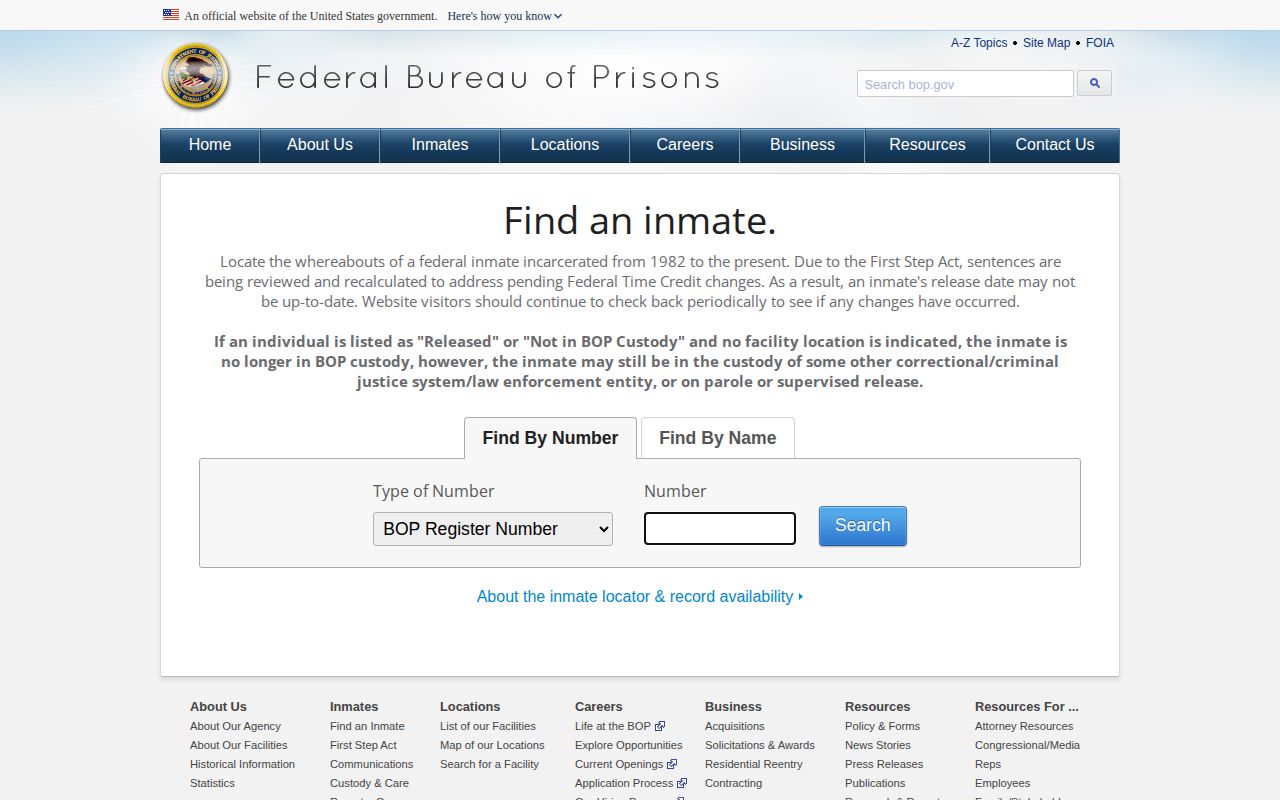
The displayed federal status must still be checked against court supervision and other custody systems.
| Source | What it can show | Limit |
|---|---|---|
| Federal court docket | Detention, release, judgment, commitment | May not show physical departure time |
| Perry jail docket | County transfer or discharge | Only the Perry custody stage |
| BOP Locator | BOP status and displayed release date | Not other custody or supervision |
| USMS contact | Case-specific assistance subject to limits | No public historical locator |
Preserve the exact label and lookup date. Do not change “Not in BOP Custody” into “free,” “living in Perry County,” or “off supervision.”
Identity matching remains essential. Compare the register number, full name, age, race, sex, and release field shown by the locator. Similar names can produce the wrong federal record. A register number is the most reliable search key when it is available from the court docket or another official source.
BOP Release Status Boundaries
BOP warns that a person listed outside its custody may be held by another correctional or law-enforcement agency. A state sentence, local warrant, immigration matter, or other transfer can continue custody after the federal prison stage. Supervised release can also continue under the federal court after physical release.
Search the other plausible jurisdiction instead of relying on one blank or released result. If a state case exists, use its corrections and court records. If the Perry sheriff docket shows a federal receiving officer, the move ended county custody but did not itself establish release from USMS or BOP.
“Not in BOP Custody” answers only whether BOP holds the person in the record shown.
Federal Pretrial Release Records
A pretrial defendant ordinarily remains under the authority of the court and USMS, even when housed in a local or private facility. Because USMS does not publish a released-person database, search the federal docket for the legal decision. Useful entries may include an order of detention, conditions of release, an acquittal, a dismissal, or a commitment after conviction.
A court release order and a physical release event remain distinct. Another warrant or detainer can affect what happens next. If Perry County housed the defendant, the county docket should record whether the person was discharged or delivered to another officer. Obtain both sources when timing or destination matters.
USMS custody can use federal, state, local, or private detention space. The building name alone does not establish which sovereign controlled the person. Read the detention order, Marshals status information available for the case, and the local receiving or transfer record together. No official source verified a routine Perry County federal placement contract.
A sentencing judgment can mark the start of the next branch, but it does not prove BOP intake occurred that day. Compare the commitment order with the Perry transfer receipt and later BOP entry. If the federal case ends before sentencing, use the court's release or dismissal order and the physical custodian's departure record.
- USMS custody
- Federal authority over many pretrial detainees and prisoner movements.
- BOP custody
- Federal prison custody for sentenced prisoners.
- Supervised release
- Court-ordered federal supervision after incarceration.
- Detainer
- An authority or request that can direct a later transfer.
Federal Release Proof Chain
The strongest file often combines sources. Use the court order for legal authority. Use the Perry docket for the local handoff when the county held the person. Use the BOP result for the sentenced federal stage and the federal docket for supervised-release terms.
If those records appear to conflict, compare dates and custody types. A county transfer may precede BOP intake. A BOP release date may precede state or immigration custody. Describe each stage separately and avoid a broad claim about freedom from all custody.
BOP Locator is also not a federal booking-photo archive. USMS limits disclosure of prisoner photographs and arrival or departure details. A lack of a public photo does not change the release analysis. Use identifiers and court records, and do not substitute an unofficial photo site for the agency custody trail.
When no online result appears, check the spelling, register number, date range, and custody stage. A pretrial detainee may never have entered the sentenced-prisoner locator. The federal docket remains the durable route for the case, while the county jail docket resolves any Perry-held segment.
A release date in the locator may coexist with a term of federal supervised release shown in the judgment. That supervision is administered through the court and probation system, not BOP prison custody. Read the judgment before describing the sentence as complete, and obtain a later court order if the supervision terms changed.
Federal and county identifiers should be preserved together when the person passed through Perry custody. The federal register number narrows a BOP search, while the Perry booking number narrows the local docket request. Using both prevents a same-name result from merging two unrelated custody histories.
Note: Record the agency, exact status phrase, source URL, and lookup date before drawing a federal custody conclusion.
Immigration Holds After Federal Release
A federal criminal-custody endpoint can lead into civil immigration detention. If a court or BOP result suggests an ICE transfer, search the ICE locator independently. Do not label the handoff community release.
ICE's detainee resources state that ODLS can retain some released-from-ICE results for 60 days. That short window can help trace the next stage. It does not expand the meaning of the BOP result or replace the federal docket.