
Perry Projected and Actual Release
“Projected release date” is the common search phrase. MDOC's public interface uses the exact label Tentative Release Date. That date is a planning estimate created from the state sentence and current computation. The actual release date is the event recorded when the facility or agency ends its custody, transfers the person, or moves the person into an authorized community status.
A pretrial detainee does not have the same kind of computed prison date. Bond, dismissal, a court order, sentencing, another hold, or transfer may determine the next event. Even after a court authorizes release, a detainer can keep the person in custody or cause a transfer. For a sentenced prisoner, MDOC may calculate parole eligibility, ERS, tentative release or discharge, and a maximum date. Those are distinct points.
- Tentative Release Date
- MDOC's public label for an estimated state-prison date that may change.
- Parole eligibility
- The point when the Board may consider release, not a promise that release will occur.
- ERS
- Earned Release Supervision, a community phase that remains under MDOC jurisdiction.
- Maximum date
- The end point calculated under the controlling sentence, subject to the official record.
Find Perry Inmate Release Dates
Start by identifying the custody system. A person sentenced into state custody belongs in the MDOC Inmate Search. A Perry County Jail sentence that never enters MDOC belongs with the court order, jail-credit or commitment record, and sheriff docket. A federal sentence belongs in the BOP locator. Mixing those paths can produce a date for the wrong case or no result at all.
- Confirm the full name, date context, booking number, cause number, or MDOC ID available for the person.
- For state custody, search MDOC by name or ID and compare the conviction county, sentence, and current location.
- Read the exact Tentative Release Date field. Record the lookup date and note when the field is blank.
- For county custody, obtain the sentencing order and jail-credit record, then ask the sheriff for the actual jail-docket release entry.
- Check the parolee search if community supervision is plausible, and request the MDOC time sheet or discharge record when precision matters.
The full Perry County release-record route explains how the sheriff docket distinguishes discharge from a transfer receipt. That permanent county record is stronger than roster disappearance.
Note: A county jail transfer into MDOC custody is not community release, even when the person disappears from the local view.
Perry Release Dates and Earned Time
For eligible sentences after June 30, 1995, the MDOC-hosted summary of Mississippi Code § 47-5-138 describes 4.5 days of earned time for each 30 days served, capped at 15 percent. Release under that framework places the person on ERS until the original term expires. MDOC keeps jurisdiction, and credits can be forfeited. The often-used “85 percent” shorthand describes this eligible structure. It is not a universal exit date.
Eligibility depends on the controlling law, offense, sentence date, and record. Multiple causes, amended judgments, revocations, and detainers may make the public sentence line incomplete. Presentence jail credit also depends on the correct cause number and county documentation. MDOC, not a public estimate, calculates the operative dates.
Parole follows a separate legal track. The Parole Board's official rules summarize different thresholds by offense, category, and controlling version of law, with exclusions and special rules. Eligibility means the Board can consider a case. It does not mean the Board granted release or fixed an actual release day. An individualized calculation needs the current official time sheet and sentence record.
Why Perry Release Dates Change
A date changes when the facts or law used in the computation change. Sometimes the public display catches up after an internal review. In other cases, a new court order or hold changes the controlling custody path. A date that has passed while the location still shows an institution is a reason to verify, not a basis to announce release.
| Factor | Possible effect | Record to check |
|---|---|---|
| County jail credit | Added or corrected credit can alter the state computation. | Cause-specific commitment and MDOC time sheet |
| Earned credits | Credits may accrue, be denied, or be forfeited. | MDOC computation record |
| New sentence or order | A new or amended judgment may change the controlling term. | Court docket and certified order |
| Detainer or revocation | Another authority may continue custody or change the sentence status. | Agency hold, court, or revocation record |
| ERS residence approval | Placement review can delay physical movement into the community. | MDOC supervision record |
| Parole decision | Grant, denial, or later review affects the parole path. | Releasable Parole Board action |
Data entry and legal review can also update the interface. Record both the displayed value and the date viewed so later changes can be explained. If the estimate conflicts with the current location, ask MDOC for the current time sheet and actual release or discharge entry.
Confirm Perry County Release Dates
For state custody, compare the MDOC location, sentence, tentative date, and separate Parolees Search. Then use the MDOC GovQA portal to request the current time computation and actual release or discharge record. If the person was released under parole or ERS, the supervision record should name that stage. A missing inmate result alone does not establish final discharge.
For Perry County Jail, ask for the public jail-docket entry required by Mississippi Code § 19-25-63. It must state how the prisoner was released or discharged and preserve the authority or transfer receipt. A court order can show legal authorization. The sheriff record confirms the physical custody event. If another agency received the person, the correct description is transfer rather than release to the community.
The Perry County VINELink release check can provide a pending event alert for a participating county or state record. Treat its notice time as evidence of the feed update. Confirm the final event with MDOC, the sheriff, or the agency shown as the reporting source.
Perry Tentative Date May Be Blank
MDOC's interface can show a Tentative Release Date, and that same field can be blank. A blank does not mean the person will never be released or has already left. It means the public detail does not display a usable estimate at that time. The controlling computation may still depend on legal review, documentation, another cause, or a status not expressed in the field.
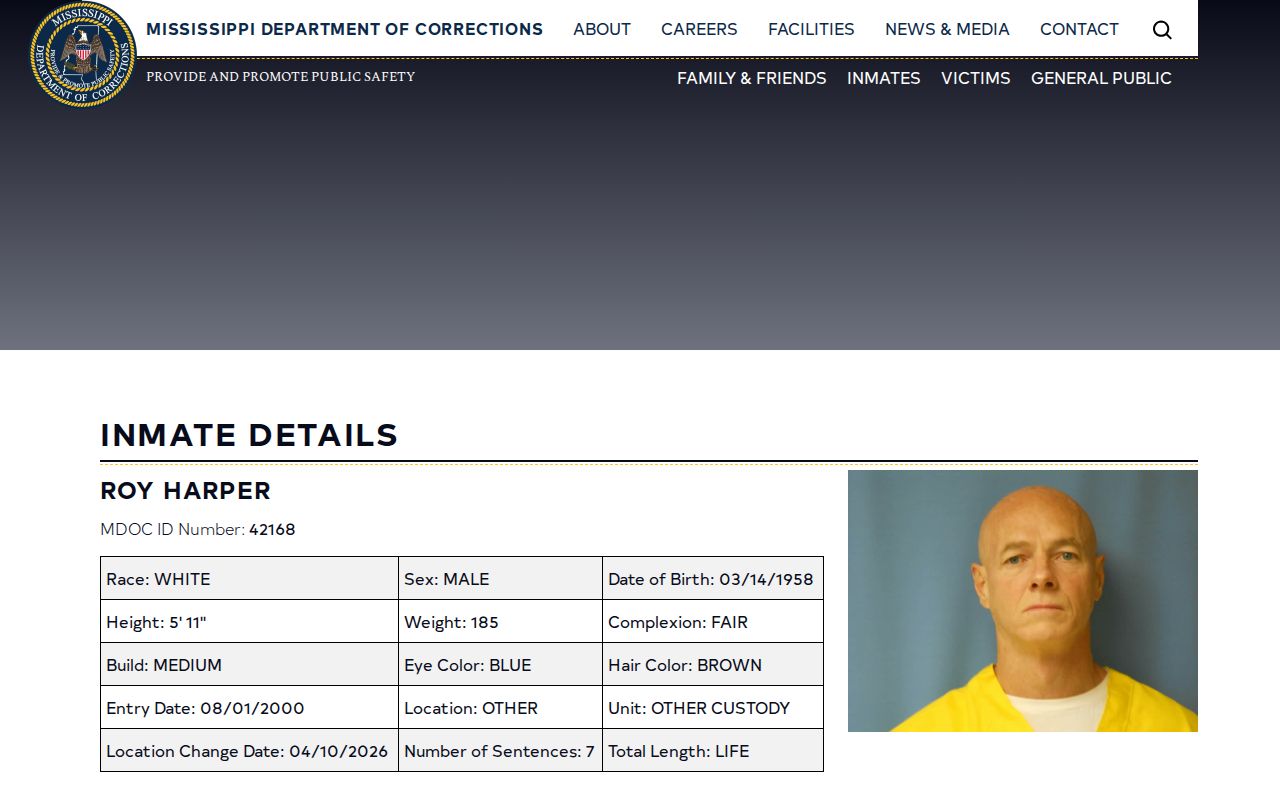
The official MDOC detail layout with a Tentative Release Date shows where the field appears beside sentence information.

The sample demonstrates the interface label only. It is not evidence about a Perry County person or proof of an actual release.
A separate MDOC public detail example demonstrates that the tentative field may be empty.
The blank example supports a cautious reading: capture the state of the field, then use the sentence record and MDOC records channel.
Perry Court and MDOC Date Records
A projected date often draws from more than one official record. The Perry or Twelfth Circuit MEC docket can show a judgment, amended order, revocation, or later case action. The sheriff's commitment and jail-credit records connect the county custody period to a cause number. MDOC then uses the state sentence and accepted credit documents in its own computation. If those records describe different causes or versions of an order, a date calculated from only one screen can be wrong.
Start with the conviction county and sentence fields shown by MDOC. Compare them with the court docket. When the public detail conflicts with a later order, obtain the certified order from the Perry County Circuit Clerk and ask MDOC whether it has been received and applied. If expected Perry jail credit is absent, identify the cause number and ask what county proof MDOC needs. Do not send a full set of sensitive identifiers to an unverified address. Use the official GovQA portal or a confirmed MDOC contact.
A request for “the release date” may return only a public screen print. Narrow wording works better. Ask for the current time-computation sheet, the Tentative Release Date and maximum date used by MDOC, any releasable earned-credit entries, and the actual release or discharge certificate if the event has occurred. If parole affects the case, ask for the releasable Board action and the community-supervision status as separate records.
The physical event still needs its own proof. A court release order establishes legal authority. An MDOC date shows a state calculation. A Perry sheriff entry shows how county custody ended. When another agency took custody, the receiving receipt completes the chain. Keeping each record in its proper role prevents an authorization date, estimate, or transfer date from being mislabeled as community release.
Perry Jail Sentence Release Records
A short county-jail sentence that never enters MDOC will not gain a valid state Tentative Release Date. Use the sentencing order, documented jail credit, commitment record, and the Perry County sheriff's public docket. No official source reviewed verifies a Perry-specific county good-time rule, weekend advance policy, release hour, or holiday practice. Those details must not be borrowed from another county.
Ask the sheriff for the complete docket entry and the exact date and time of release or transfer. Include the person's name, aliases, booking number if known, and a reasonable date range. If the docket records a penitentiary officer's receipt or another authority, follow that receiving system. If it records bond, time served, dismissal, or another discharge basis, keep that phrase tied to the specific cause because a separate hold can still control custody.
When court and jail dates differ, the records may answer different questions. The court date can show when release was authorized. The jail entry can show when physical custody ended. Preserve both and ask the agencies to explain any unresolved gap rather than forcing one date to serve both roles.
Keep the case number with every date. One charge may be dismissed while another sentence or hold remains active. The most accurate record set ties the court authority, jail event, and any receiving-agency record to the same person and cause. This prevents a date from one case from being presented as the end of all Perry County custody.
Note: No verified Perry rule supports advancing a county release for a weekend or calculating local good time from a generic formula.